How to Set Up a 2-of-3 Bitcoin Multisig Wallet With Hardware Wallets
A 2-of-3 Bitcoin multisig wallet requires any two of three independent signing keys to authorize a spend. Combined with hardware wallets, this can create a security architecture where losing one device does not automatically mean losing access to funds.
But multisig is not simply “three hardware wallets instead of one.” The wallet policy, derivation information, extended public keys, backups, recovery process and transaction-signing workflow all have to remain consistent.
This guide explains the architecture first, then walks through the important setup and verification concepts using Sparrow Wallet as the example coordinator. It also explains PSBTs, recovery, backup distribution and the mistakes that can make a multisig wallet difficult or impossible to recover.
What Is 2-of-3 Bitcoin Multisig?
Bitcoin multisignature, commonly abbreviated as multisig, allows a spending policy to require more than one authorized signature.
In a 2-of-3 configuration, the wallet has three authorized signing keys, but a transaction requires signatures from any two of them.
2 signatures required / 3 signing keys available
The important distinction is between the number of keys participating in the wallet policy and the number of signatures required to spend.
| Configuration | Keys | Required signatures |
|---|---|---|
| 1-of-1 | 1 | 1 |
| 2-of-3 | 3 | 2 |
| 2-of-4 | 4 | 2 |
| 3-of-5 | 5 | 3 |
Why Use a 2-of-3 Multisig Wallet?
The main security property of 2-of-3 multisig is that one compromised, destroyed or unavailable signing key does not necessarily make the wallet permanently inaccessible.
Protection against a single lost device
If one hardware wallet stops working, the remaining two signing keys can still satisfy the 2-of-3 policy, assuming the wallet configuration and backups have been preserved correctly.
Reduced dependence on one signing device
A traditional single-signature wallet normally depends on one private-key backup being correct and available. Multisig distributes the signing authority across multiple keys.
Physical separation
The three signing devices and their backups can be stored separately. This can reduce the consequences of a single physical event such as theft, fire or loss of one storage location.
But multisig creates new risks
Multisig is not automatically safer merely because it contains more keys. A badly documented multisig wallet can be harder to recover than a single-signature wallet.
You must preserve enough information to reconstruct the wallet policy: the signing keys, derivation information, wallet type, script policy and the public information required by the coordinator.
How a 2-of-3 Bitcoin Multisig Wallet Works
Imagine three independent signing keys:
| Signer | Role | Private key location |
|---|---|---|
| Key A | Signer 1 | Hardware wallet A |
| Key B | Signer 2 | Hardware wallet B |
| Key C | Signer 3 | Hardware wallet C |
The wallet coordinator knows the public information associated with those three keys. It can therefore derive addresses and construct transactions without needing the private keys.
To spend bitcoin, the transaction is created and passed between the necessary signing devices. Two valid signatures are sufficient to satisfy the 2-of-3 policy.
Key A + Key B = valid spendKey A + Key C = valid spendKey B + Key C = valid spendKey A alone = insufficient
This is the fundamental idea behind the configuration.
What Does Each Hardware Wallet Actually Do?
A hardware wallet's most important role is protecting its private key and performing signing operations without exposing that private key to the computer coordinating the transaction.
Sparrow's documentation explains that connected hardware wallets receive transactions to sign and return signatures, while the private key remains inside the hardware device. The device screen can also be used to verify transaction information before approval.
That makes the hardware wallet the signing boundary, while the desktop wallet acts as the coordinator and transaction interface.
Private Keys, Seeds and Extended Public Keys
One of the most important concepts in multisig is the difference between private and public wallet information.
Seed phrase
A hardware wallet seed is sensitive private information. Anyone who obtains the necessary seed material may be able to recreate the associated signing key.
Extended public key
An extended public key, commonly called an xpub or another extended public key variant depending on the script and network, allows software to derive public addresses and observe wallet activity without directly possessing the private signing key.
In a multisig wallet, the coordinator needs the public information from all signing keys so it can derive the correct wallet addresses.
BIP48 and Multisig Derivation
BIP48 defines a deterministic hierarchy for multisignature wallets. Its proposed hierarchy extends the familiar HD-wallet path structure with a script-type level for multisig.
The general structure defined by BIP48 is:
m / purpose' / coin_type' / account' / script_type' / change / address_index
BIP48 specifically uses the 48' purpose for multisignature
wallet derivation schemes that implement the standard.
However, this does not mean that every multisig wallet automatically uses the same derivation path. Wallet software, script type, network and compatibility requirements matter.
A Practical 2-of-3 Architecture
A robust setup starts by deciding where each signing key and its backup will live before depositing significant bitcoin.
Hardware wallet with its own seed and backup.
Independent hardware wallet with a separate seed and backup.
Independent hardware wallet with a separate seed and backup.
Sparrow or another compatible wallet software stores the public wallet configuration and coordinates transaction construction and signing.
Sparrow supports multisignature wallets, hardware-wallet keystores, watch-only information and PSBT-based signing workflows. Its documentation also provides connected and air-gapped hardware-wallet workflows.
The Multisig Policy Is the Core of the Wallet
The most important piece of information in a multisig wallet is not simply the number of hardware wallets sitting on your desk. It is the exact spending policy that determines which keys can authorize which outputs.
For a 2-of-3 policy, the wallet needs three public signing keys and requires two valid signatures.
2-of-3 = 2 required signatures from 3 authorized keys
Modern Bitcoin wallet software can describe such policies using output
descriptors. Bitcoin Core documents multisig descriptors using functions
such as multi() and sortedmulti().
Why sortedmulti matters
The order of keys can matter when using a normal multisig expression.
sortedmulti() sorts the public keys deterministically according
to BIP67, reducing ambiguity about key ordering when reconstructing the
same policy.
A conceptual example of a native SegWit multisig descriptor is:
wsh(sortedmulti(2,KEY_A,KEY_B,KEY_C))
This is an explanatory representation, not a descriptor that you should copy into a wallet. Real descriptors contain actual extended public keys, derivation paths, key-origin information and, where applicable, a checksum.
Why Key-Origin Information Matters
A multisig coordinator needs more than three strings that look like xpubs. Hardware-wallet interoperability can depend on knowing where each public key originated and which derivation path produced it.
This information can include the master key fingerprint and derivation path associated with the extended public key.
Losing this information may not immediately make the bitcoin unspendable, but it can make wallet reconstruction and hardware-wallet verification significantly more difficult.
Before You Create the Wallet
Do not start by sending bitcoin.
First build the complete configuration with test funds and prove that you can receive, sign, recover and spend.
| Preparation | What to verify |
|---|---|
| Hardware wallet A | Authentic device, initialized correctly, seed backed up |
| Hardware wallet B | Independent seed and backup |
| Hardware wallet C | Independent seed and backup |
| Coordinator | Correct wallet software and trusted installation |
| Wallet policy | 2-of-3 confirmed |
| Derivation | Correct script type and derivation information |
| Recovery | Documented and tested |
Create Three Independent Signing Keys
Each signer should have its own private key material. In a typical hardware-wallet setup, this means each device has its own seed.
Do not make three devices from the same seed and assume that this creates three independent multisig keys. Replicating one seed across several devices does not provide the same key-distribution property as three independent seeds.
Record the information needed for recovery
For each signer, maintain a secure record of the information required to identify that signer later. Depending on the wallet implementation, this can include:
- Hardware-wallet identifier or label
- Master key fingerprint
- Extended public key
- Derivation path
- Script type
- Network
- Wallet policy
Never put seed phrases into the same ordinary document containing all of this public wallet metadata.
Collect the Public Information
Once each hardware wallet has been initialized, import the appropriate public key information into the coordinator.
The objective is not to transfer the private keys to Sparrow. The objective is to let Sparrow understand how the three signing keys participate in the multisig wallet.
Sparrow's hardware-wallet documentation describes this distinction: public key information can be imported while the private key remains protected by the hardware wallet.
Create the Multisig Wallet in Sparrow
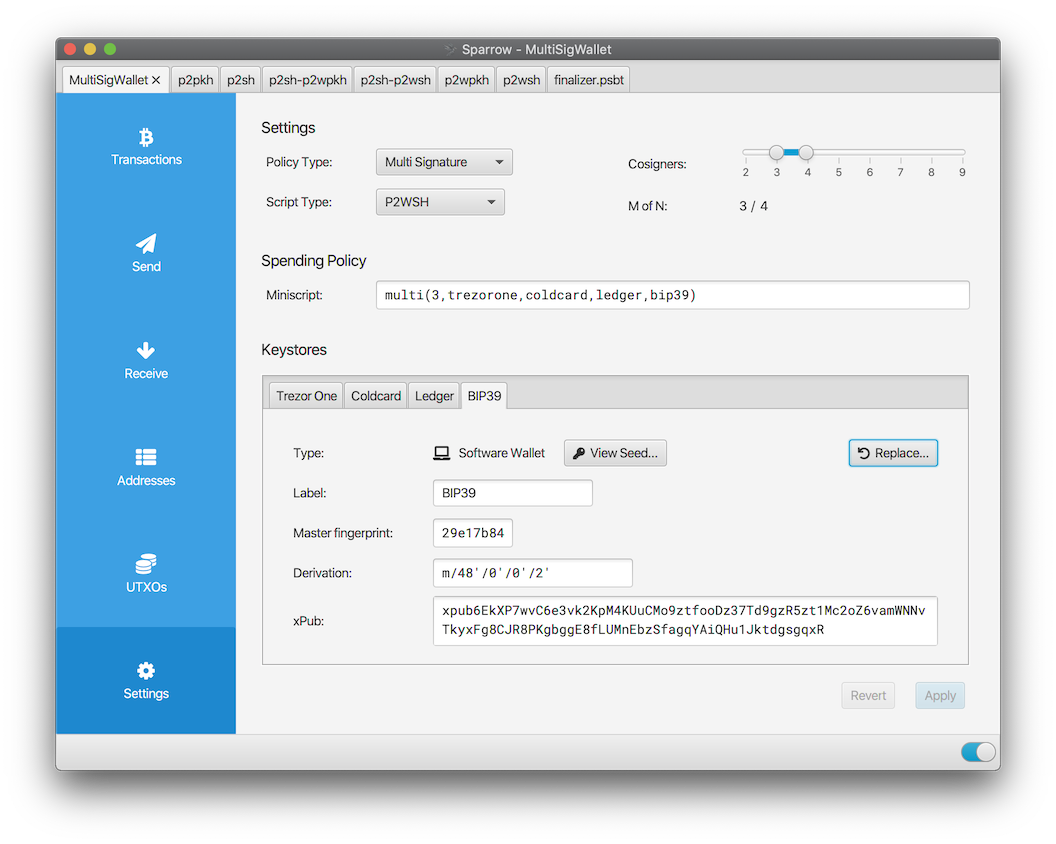
In Sparrow, create a new wallet and select a multisignature policy. The exact interface can change between versions, so use the current controls displayed by the installed version rather than following a screenshot blindly.
Select:
- Policy type: Multi Signature
- Required signatures: 2
- Total cosigners: 3
- Script type: the intended compatible script policy
Do not mix script types accidentally
Bitcoin supports several address and script constructions. Native SegWit, nested SegWit, legacy and Taproot are not interchangeable simply because they are all Bitcoin addresses.
The script policy selected when the wallet is created must match the derivation information and the hardware-wallet configuration used by the signers.
Verify All Three Keystores
Before receiving funds, inspect each signer entry.
You should be able to distinguish:
- Signer A
- Signer B
- Signer C
Confirm that the public information corresponds to the intended hardware device. If the wallet software provides a fingerprint or derivation path, compare it with the information shown by the hardware wallet.
Generate and Verify a Receiving Address
This is one of the most important tests in the entire process.
Generate a receiving address from the multisig wallet and verify that the expected hardware-wallet interfaces recognize the wallet configuration.
Do not send a large amount merely because the desktop application displays a plausible address.
The address must belong to the multisig policy you intended to create.
Use a Small Test Deposit
Send a small amount to the multisig wallet.
Wait for the transaction to appear in the wallet and verify the resulting UTXO and balance.
Then perform a complete test spend requiring two signatures.
Build a Recovery Map Before Funding the Wallet
A multisig backup is more than three seed phrases.
You also need enough public wallet information to reconstruct the same wallet policy later.
| Backup item | Why it matters |
|---|---|
| Seed A | Recovery of signer A |
| Seed B | Recovery of signer B |
| Seed C | Recovery of signer C |
| Wallet policy | Defines 2-of-3 authorization |
| Extended public keys | Allow wallet reconstruction and address derivation |
| Derivation information | Determines which addresses belong to the wallet |
| Script type | Defines the address/script construction |
What Is a PSBT?
PSBT stands for Partially Signed Bitcoin Transaction. It is a standardized format for exchanging Bitcoin transactions that are not yet completely signed.
This is particularly useful for multisig because different signers can independently review and sign the same transaction without sharing their private keys.
Bitcoin Core's documentation describes PSBT as an interchange format for transactions together with the metadata required to progress toward a completed transaction. It specifically identifies hardware-wallet and multisig workflows as use cases.
A simplified PSBT lifecycle
The coordinator creates the proposed transaction.
Inputs, outputs, amounts and fees are reviewed.
Signer A reviews the transaction and adds its signature.
Signer B independently reviews the transaction and adds its signature.
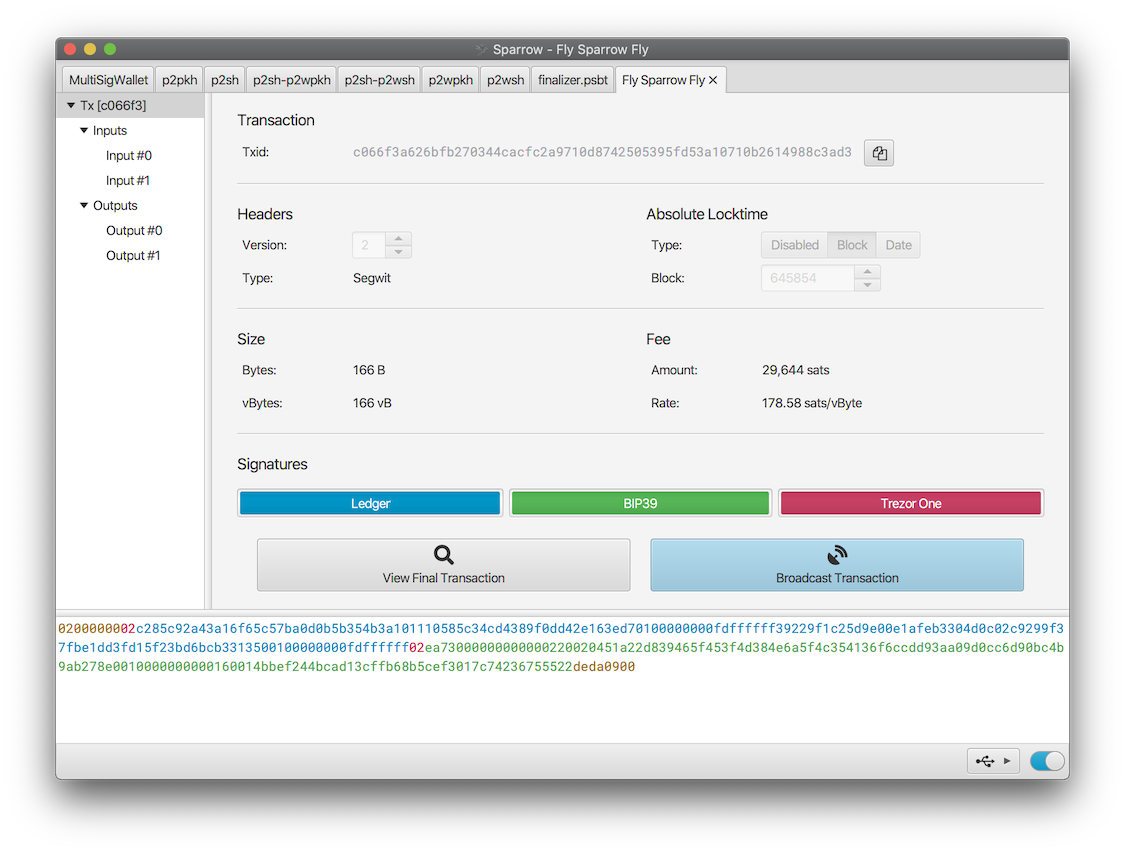
Once enough signatures are present, the transaction can be finalized.
The completed transaction is transmitted to the Bitcoin network.
Step 1: Create the Transaction
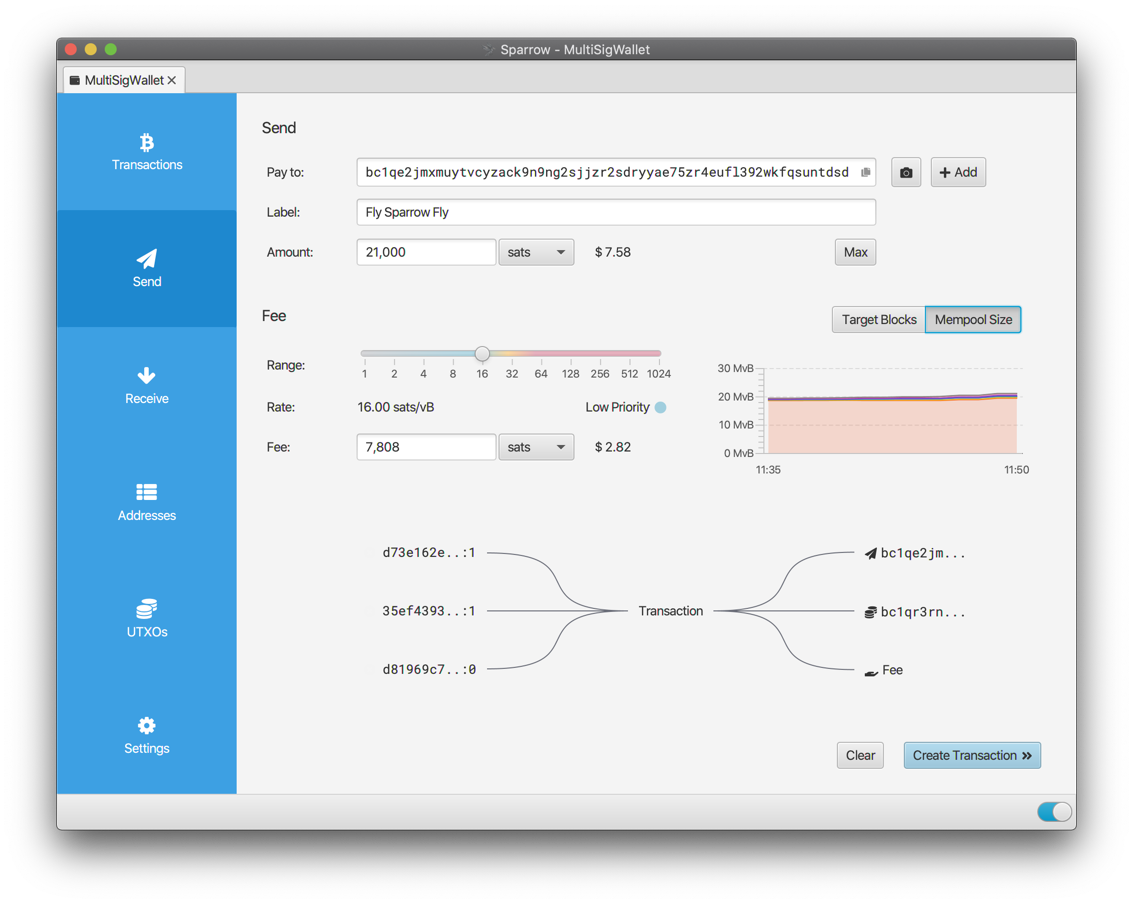
Open the multisig wallet and create a transaction normally through the wallet interface.
Before signing anything, inspect the transaction itself.
- Destination address
- Bitcoin amount
- Inputs being spent
- Change output
- Network fee
- Fee rate
- Transaction locktime when relevant
The objective is to verify what the transaction actually does, not merely verify that the wallet software created a transaction successfully.
Step 2: Verify on the Hardware Wallet
A compromised computer can potentially display misleading information. That is why the hardware wallet screen matters.
Sparrow's documentation specifically recommends checking transaction details on the hardware-wallet device rather than relying only on the computer display.
At minimum, pay attention to the destination and amount. Also verify any change output and transaction information presented by the device.
Step 3: Sign With Hardware Wallet A
Connect or otherwise communicate with hardware wallet A using the wallet's supported signing method.
The PSBT is transferred to the signer. The hardware wallet verifies the relevant transaction information and, after approval, produces its signature.
The private key itself remains protected by the hardware wallet.
Step 4: Sign With Hardware Wallet B
Transfer the partially signed transaction to hardware wallet B.
Do not treat the second signature as a formality.
Signer B should independently review the transaction before approving it. A second signer that blindly approves whatever appears on the screen does not provide the same verification value as an independent review.
Step 5: Finalize the Transaction
Once two valid signatures have been added, the PSBT should contain enough signatures to satisfy the 2-of-3 policy.
The wallet software can then finalize the transaction and prepare the fully signed transaction for broadcast.
Bitcoin Core documents functions for combining PSBTs, finalizing them and extracting the resulting transaction when the required signatures are present.
Step 6: Broadcast and Verify
After finalization, broadcast the transaction through your chosen Bitcoin infrastructure.
Record the transaction ID and verify that the transaction appears as expected.
Then confirm the receiving wallet receives the expected amount and that the original multisig wallet reflects the expected remaining balance.
The Three Valid 2-of-3 Combinations
| Available signers | Meets 2-of-3? |
|---|---|
| A + B | Yes |
| A + C | Yes |
| B + C | Yes |
| A only | No |
| B only | No |
| C only | No |
Connected vs Air-Gapped Signing
Hardware-wallet multisig does not require every device to be connected by USB.
Sparrow supports both connected hardware wallets and air-gapped workflows. Air-gapped devices can exchange transaction data using mechanisms such as QR codes or SD cards, depending on the device.
The security model is different from simply plugging a hardware wallet into the computer, but the fundamental requirement remains the same: the signer must verify the transaction before approving it.
USB, QR and SD Card Workflows
| Method | General idea | Consideration |
|---|---|---|
| USB | Wallet software communicates directly with the hardware wallet | Simple and convenient |
| QR | Transaction data is transferred optically | Useful for air-gapped workflows |
| SD card | PSBT files are transferred using removable media | Useful for supported air-gapped devices |
The exact method depends on the hardware wallet and its current firmware and software support.
What to Check Before Every Signature
- Is this the transaction you intended to make?
- Is the destination address correct?
- Is the amount correct?
- Is the fee reasonable for the transaction?
- Is the change output going where you expect?
- Are the inputs the UTXOs you intended to spend?
- Does the hardware wallet display information consistent with the transaction?
How to Recover a 2-of-3 Bitcoin Multisig Wallet
Recovery is where many multisig setups reveal whether they were actually documented correctly.
The goal is not simply to restore one seed phrase. The goal is to reconstruct the same wallet policy and regain access to enough signing keys to satisfy the 2-of-3 requirement.
Example: one hardware wallet is lost
Suppose hardware wallet A is destroyed.
If you still have B and C, the 2-of-3 policy can still be satisfied. You can therefore continue spending from the wallet, provided the wallet configuration can be reconstructed correctly and the remaining signers are available.
Example: two hardware wallets are lost
If A and B are unavailable but C remains, C alone cannot satisfy a 2-of-3 policy.
This is why the phrase “multisig protects against loss” needs qualification: it protects against certain single-key failures, but not against losing enough independent signing authority to fall below the required threshold.
Test Recovery Before You Need It
A backup that has never been tested is an assumption, not a verified recovery plan.
Perform a controlled recovery test using a small test wallet or test environment before committing significant funds to the configuration.
The test should answer:
- Can each seed restore the expected signer?
- Can the public wallet configuration be reconstructed?
- Do the expected receiving addresses appear?
- Can two restored signers authorize a test transaction?
- Can the resulting transaction be finalized and broadcast?
What Should Be Documented?
Your recovery documentation should contain enough information to rebuild the wallet without relying on memory.
| Information | Example purpose |
|---|---|
| Policy | Confirms that the wallet is 2-of-3 |
| Script type | Identifies the Bitcoin output construction |
| Signer A fingerprint | Identifies the origin of signer A |
| Signer B fingerprint | Identifies the origin of signer B |
| Signer C fingerprint | Identifies the origin of signer C |
| Extended public keys | Reconstruct public wallet information |
| Derivation paths | Derive the intended address branches |
| Wallet software | Know which coordinator was used |
Distribute the Backups
The point of 2-of-3 is not merely to have three devices in one drawer.
Physical separation can reduce the consequences of localized events. For example, storing all three devices and all three backups in the same building creates a single physical failure domain.
Sparrow's best-practices documentation recommends considering multiple hardware-wallet vendors and different physical locations for multisig cold-storage configurations. This is a hardening strategy, not a universal requirement for every user.
A conceptual distribution
| Location | Signer | Backup |
|---|---|---|
| Location A | Hardware wallet A | Controlled separately |
| Location B | Hardware wallet B | Controlled separately |
| Location C | Hardware wallet C | Controlled separately |
The exact physical arrangement should reflect your own threat model, availability requirements and ability to maintain the backups.
Should the Three Hardware Wallets Be Different?
There is no mathematical requirement that the three signers come from different manufacturers.
However, using different vendors can reduce dependence on one manufacturer's implementation or supply chain. Sparrow's own best-practices documentation explicitly discusses using hardware wallets from multiple vendors as a hardening measure.
The trade-off is increased operational complexity. Three different devices may have different interfaces, firmware processes, backup formats and signing procedures.
What If One Seed Is Compromised?
This is one of the major differences between losing a hardware wallet and losing control of its seed.
If an attacker obtains one private seed, the 2-of-3 policy still requires another valid signing key for an ordinary spend.
But you should treat the compromised signer as permanently compromised. Replacing the hardware device alone does not remove the attacker's copy of the seed.
General response
- Stop using the affected signer for the old wallet.
- Preserve the evidence needed to understand the incident.
- Use the remaining valid signing authority to move funds to a new policy.
- Generate a completely new signing key for the replacement signer.
- Rebuild and test the new wallet before relying on it.
What If One Hardware Wallet Is Lost?
Loss of the physical device and compromise of the seed are different scenarios.
If the seed backup remains secure and the device itself is unavailable, the signer can potentially be restored on another compatible hardware wallet.
The exact recovery process depends on the device, wallet standard and configuration. Do not assume that every hardware wallet uses identical derivation paths or import procedures.
What About a Hardware-Wallet Passphrase?
A passphrase can create an additional wallet derived from the underlying seed, depending on the hardware wallet implementation.
This means a forgotten or incorrectly entered passphrase can result in a wallet that appears empty even though the original wallet still exists.
If a multisig setup uses passphrases, the passphrase becomes another critical recovery dependency and must be handled as such.
Multisig and Privacy
Multisig improves authorization security, but it does not automatically provide perfect privacy.
Wallet metadata, extended public keys, transaction history, address reuse, server connections and UTXO-management practices can all affect privacy.
A watch-only coordinator can be especially useful for monitoring a wallet, but anyone who obtains sufficiently powerful public wallet information may be able to reconstruct significant portions of its transaction history.
Keep public wallet data protected even though it cannot directly authorize a Bitcoin spend.
Common 2-of-3 Bitcoin Multisig Mistakes
1. Funding the wallet before testing recovery
This is one of the most dangerous operational mistakes. Build the wallet, receive a small test amount, spend it and test recovery before increasing the balance.
2. Losing the wallet configuration
Three seed phrases alone may not be enough for a smooth recovery. Preserve the public wallet configuration, derivation information and policy details.
3. Using the wrong derivation path
A seed can produce different wallet branches under different derivation paths. If the restored wallet shows different addresses, investigate the path and script configuration before concluding that the funds disappeared.
4. Mixing incompatible script policies
Native SegWit, nested SegWit, legacy and Taproot constructions have different characteristics. The wallet policy and all signers must be configured consistently.
5. Treating xpubs as harmless public data
An xpub does not normally authorize spending, but it can expose substantial wallet history and address information.
6. Keeping all three backups together
This creates a single physical failure point.
7. Putting all three seeds into one digital file
This defeats much of the intended key distribution and creates an extremely valuable target for malware or unauthorized access.
8. Signing without checking the transaction
Multisig does not help if two signers blindly approve the same malicious transaction.
9. Assuming hardware-wallet brands are interchangeable
Different manufacturers can implement different derivation paths, supported scripts, signing interfaces and backup procedures. Compatibility must be verified rather than assumed.
10. Never performing a recovery drill
The first recovery attempt should not happen after a disaster.
2-of-3 Bitcoin Multisig Security Checklist
- ☐ Three independent signing keys created
- ☐ Each seed backed up securely
- ☐ 2-of-3 policy confirmed
- ☐ Script type confirmed
- ☐ Derivation paths documented
- ☐ Master fingerprints recorded where appropriate
- ☐ Extended public keys recorded securely
- ☐ Wallet configuration documented
- ☐ Receiving address verified
- ☐ Small test deposit completed
- ☐ Test transaction completed with two signatures
- ☐ Recovery procedure tested
- ☐ Physical backups separated appropriately
- ☐ Passphrase information documented if used
- ☐ No seed phrase stored on an internet-connected computer
Transaction Signing Checklist
Before each signature:
- ☐ Confirm the intended destination
- ☐ Confirm the amount
- ☐ Confirm the inputs
- ☐ Confirm the change output
- ☐ Review the network fee
- ☐ Inspect the transaction on the hardware wallet
- ☐ Only then approve the signature
Frequently Asked Questions
Is 2-of-3 multisig safer than a normal hardware wallet?
It provides a different security model rather than a universal guarantee that it is safer for every user. It can reduce dependence on a single signing key, but it also introduces additional configuration and recovery requirements.
Can I lose one hardware wallet and still access the bitcoin?
In a correctly configured 2-of-3 wallet, two remaining valid signing keys can satisfy the spending threshold. The wallet configuration must also be recoverable.
Do I need three different hardware-wallet brands?
No. Different vendors can be used as a hardening strategy, but they are not mathematically required for a 2-of-3 policy.
Can one hardware wallet sign a 2-of-3 transaction?
One signature alone does not satisfy a 2-of-3 policy. Two valid signatures are required.
Does multisig eliminate the need for backups?
No. Multisig changes the backup strategy; it does not eliminate it. You still need enough independent signing authority and enough wallet metadata to reconstruct the policy.
What happens if I lose two of the three seeds?
The remaining single key cannot satisfy a 2-of-3 threshold. Recovery depends on whether the lost signing authority can be restored from secure backups.
What is PSBT used for in multisig?
PSBT provides a standardized way for wallets and signers to exchange a transaction and the information needed to add signatures without sharing the private keys.
Can I use Sparrow with hardware wallets?
Yes. Sparrow documents support for connected and air-gapped hardware-wallet workflows and supports multisignature wallets.
Can I use multisig without Sparrow?
Yes. Sparrow is used in this article as a practical example, but Bitcoin multisig can be implemented by other compatible wallet software and systems. The important part is maintaining compatible standards and preserving the wallet's recovery information.
Should I use multisig for all my Bitcoin?
There is no universal answer. The appropriate architecture depends on the amount involved, threat model, technical ability, recovery requirements and tolerance for operational complexity.
Final Takeaway
A 2-of-3 Bitcoin multisig wallet is best understood as a complete security architecture rather than simply three hardware wallets connected to a computer.
The three signing keys provide distributed authorization. The coordinator maintains the public wallet configuration. PSBTs provide a practical way to move partially signed transactions between signers. Hardware wallets protect private signing keys and provide an independent place to review transaction details.
The most important part, however, is recoverability.
Before trusting a multisig wallet with meaningful funds, you should know exactly how to reconstruct the policy, where every required signing key is backed up, which derivation paths are being used and how two signers will create a valid transaction after a device is lost.
Technical Sources and Further Reading
The following resources were used to verify the technical concepts covered in this guide.
- Sparrow Wallet Documentation
- Sparrow Wallet — Connected Hardware Wallet
- Sparrow Wallet — Best Practices
- Bitcoin Core — Multisig Tutorial
- Bitcoin Core — PSBT Howto
- Bitcoin Core — Output Descriptors
- BIP48 — Multi-Script Hierarchy for Multi-Sig Wallets
Related ColdStorageHub Guides
Continue learning about Bitcoin self-custody and hardware-wallet security:
- Hardware Wallet Security: The Complete Guide
- Seed Phrase Security: The Complete Guide
- How to Verify a Bitcoin Transaction Before Signing
- Watch-Only Bitcoin Wallets and xPub Privacy
- What Happens If You Lose Your Hardware Wallet?
- Crypto Security Checklist 2026
ColdStorageHub focuses on practical Bitcoin security, hardware wallets, cold storage, seed protection and self-custody.
Security practices should always be tested with small amounts before being trusted with larger balances. Hardware-wallet interfaces, supported scripts and wallet software can change over time, so consult the current documentation for the exact devices and software you use.